The 2026 SSS Contribution Table, Explained Simply
What the SSS Contribution Table Is (and Why 2026 Matters)
If you run payroll in the Philippines, the SSS contribution table is one of those references you end up opening every single cutoff. It tells you exactly how much you and your employee each owe the Social Security System based on that employee's salary. For 2026, the table matters more than usual because it reflects the final scheduled step of Republic Act 11199, the Social Security Act of 2018. That law mapped out a gradual climb in the contribution rate over several years, and 2026 is where it lands at its top figure.
The good news is that once you understand the handful of rules behind the table, you never have to memorize hundreds of rows. The whole thing runs on one input (the employee's Monthly Salary Credit), one rate (15%), and a fixed split between employer and employee. In this guide we'll walk through the 2026 numbers in plain English, show a sample of the brackets with real peso amounts, and explain what the employer's larger share is actually paying for. No jargon, no guesswork, just the figures you need to get your remittances right. Whether you're a first-time employer registering your business with SSS or an HR staffer double-checking a payroll run, the same three rules apply, and they haven't changed shape in 2026, only settled at their final rate.
The Headline Numbers: 15% Total, Split 5% and 10%
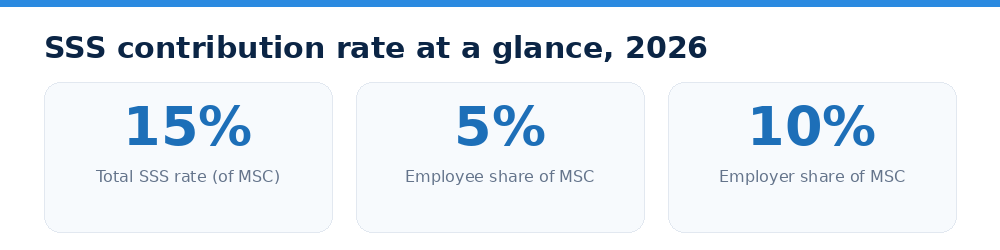
For 2026, the total SSS contribution rate is 15% of the Monthly Salary Credit (MSC), and that rate is now fully in effect. What trips people up is that the 15% is not paid entirely by the worker. It is shared: the employee pays 5% of the MSC and the employer pays 10% of the MSC. So for every peso of contribution, the employer shoulders two-thirds and the employee one-third.
This is different from PhilHealth and Pag-IBIG, which split their premiums evenly. With SSS, the business carries the heavier load by design. A quick way to sanity-check any payslip: whatever amount is deducted from the employee for SSS, the employer's own share should be roughly double that, before adding the small Employees' Compensation fee. Keep the 5-and-10 split in your head and most of the table becomes predictable. If you ever see an employee deduction that equals 10% or the full 15% of salary, something is being computed wrong.
It's also worth knowing why the rate climbed to 15%. RA 11199 authorized a series of increases specifically to keep the SSS fund solvent and to extend the life of the pension pool for future retirees. Each step was announced ahead of time so employers could budget for it, and 2026 simply marks the last of those scheduled bumps. From a payroll standpoint, that means one less moving part to worry about year over year, at least until the law is revisited.
Monthly Salary Credit: The Number Everything Is Based On
The Monthly Salary Credit is the heart of the whole system, so it's worth getting comfortable with. SSS does not apply the 15% directly to an employee's actual salary. Instead, it slots that salary into a bracket, and each bracket has an assigned MSC. The 15% is then applied to the MSC, not to the raw pay.
The brackets move in fixed PHP 500 increments, and they are bounded on both ends. The floor is PHP 5,000: even if an employee earns less, contributions are computed as if the MSC were 5,000. The ceiling is PHP 35,000: no matter how high the salary climbs, the MSC is capped there. That cap is why SSS contributions stop growing past a certain income.
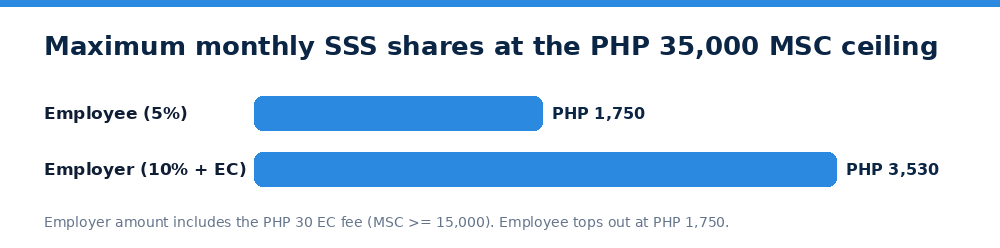
Because the MSC tops out at 35,000, the maximum employee share is 5% x 35,000 = PHP 1,750 per month, and the maximum employer share (excluding EC) is 10% x 35,000 = PHP 3,500. So the most any single employee will ever have deducted for SSS in 2026 is PHP 1,750. Someone earning 35,000 and someone earning 350,000 land on the same MSC and pay the same amount. Knowing the floor, the ceiling, and the 500-peso step lets you locate any employee on the table in seconds.
Sample MSC Brackets and What Each Side Pays
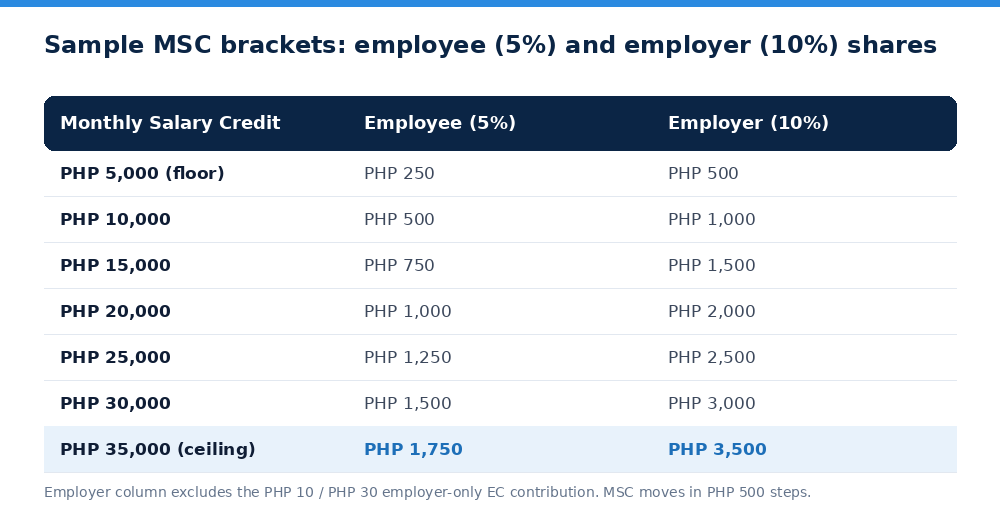
Here's how the math plays out across a spread of MSC brackets. Each row applies the 5% employee and 10% employer rates to the MSC, so you can see how the burden scales. Notice that the two shares always keep the same 1:2 ratio, and that everything freezes once you hit the 35,000 ceiling.
The table below leaves out the small Employees' Compensation fee (PHP 10 or PHP 30, employer-paid) so you can focus on the core split; we'll cover EC next. Use these as reference points rather than an exhaustive list. The official SSS schedule contains every 500-peso bracket in between, but the pattern never changes: multiply the MSC by 5% for the worker and by 10% for the business. If you can compute one row by hand, you can compute all of them, which is exactly why a good payroll system just needs the salary and lets the rest fall out automatically. One more thing to watch: an employee's MSC is based on their monthly compensation, so give-and-take items like a mid-year raise can push someone into a higher bracket. When that happens, both the employee deduction and the employer share step up together in line with the table.
What the Employer's 10% Actually Covers
The employer's 10% is not one flat deposit into a single fund. It bundles a few components that RA 11199 folded together. The bulk of it is the regular SSS retirement, disability, sickness, and maternity coverage. On top of that, employers pay the Employees' Compensation (EC) contribution, a separate program that covers work-related injury and illness. EC is employer-only and modest: PHP 10 per month when the MSC is below 15,000, and PHP 30 per month when the MSC is 15,000 or above. Employees never pay EC.
There is also the Workers' Investment and Savings Program (WISP), a mandatory provident savings layer for members whose MSC sits above 20,000. WISP is not a separate bill you compute on the side in most cases; it is carved out of the contributions on the upper MSC brackets and set aside to grow as a supplementary benefit for higher earners.
The practical takeaways for payroll: the employee always pays a clean 5% of MSC and nothing more, while the employer's remittance is the 10% plus the small EC fee. When you file, those pieces are reported together, but understanding them helps when you reconcile totals or explain a payslip to staff.
A Quick Worked Example and Common Mistakes
Let's put it together with a worker earning PHP 25,000 a month. That salary falls on the 25,000 MSC bracket. The employee share is 5% x 25,000 = PHP 1,250, deducted from their pay. The employer share is 10% x 25,000 = PHP 2,500, plus the PHP 30 EC fee because the MSC is at least 15,000, for PHP 2,530. Total going to SSS: PHP 3,780. The employee sees only the PHP 1,250 line on their payslip.
A few mistakes to avoid: don't apply the 15% to the raw salary (it goes to the MSC); don't forget the 5,000 floor for low earners or the 35,000 ceiling for high earners; and don't deduct EC from the employee, since it's employer-only. Also remember that contribution rates and the MSC schedule can be updated by SSS, so treat the 2026 figures here as current-year reference and confirm edge cases (like new hires mid-month or separated employees) against the official SSS circular.
Getting these right every cutoff is tedious by hand but trivial to automate. Sahodly computes each employee's MSC, split, and EC automatically and generates your remittance figures, so you can stop cross-checking the table row by row. Try Sahodly free and let your next SSS run compute itself.