PhilHealth 5% Premium in 2026: How Much Comes Out of Your Pay
PhilHealth stays at 5% in 2026
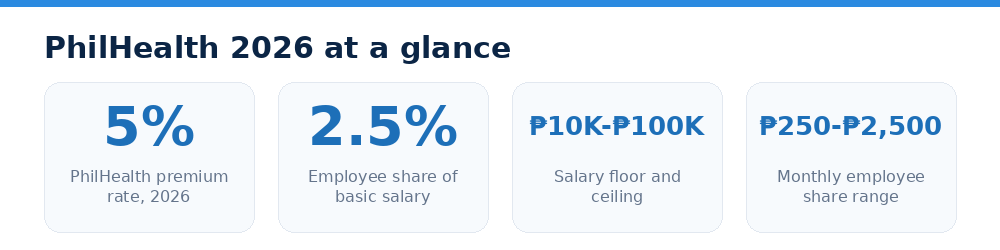
If you receive a payslip in the Philippines, PhilHealth is one of the three government deductions you will always see, alongside SSS and Pag-IBIG. For 2026, the premium rate stays at 5% of your monthly basic salary — the same rate that has been in place since 2024, with no increase this year.
The 5% is not all yours to shoulder. It is split evenly between you and your employer: 2.5% comes out of your pay, and the other 2.5% is paid by your employer. So on a straightforward salary, PhilHealth costs you exactly half of the headline rate.
PhilHealth is administered by the Philippine Health Insurance Corporation, and the 5% figure represents the last of the scheduled increases under the Universal Health Care Act. Because the rate is now steady, 2026 is a good year to lock in a correct payroll setup and stop second-guessing the percentage each January.
That single rate hides a bit of nuance, though. PhilHealth applies a salary floor and a ceiling, which means the lowest and highest earners do not simply pay 5% of whatever they make. Below we break down exactly how the math works, how much actually lands on your payslip, and what your employer has to do with it.
The floor and ceiling that cap your premium
PhilHealth does not charge 5% on every peso. It sets a band. For 2026 the income floor is ₱10,000 and the income ceiling is ₱100,000 of monthly basic salary.
Here is what that means in practice:
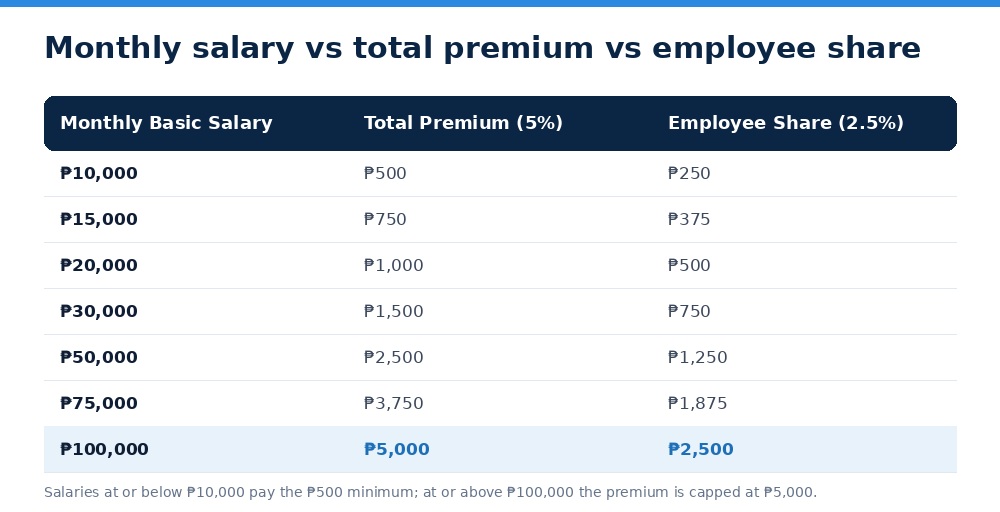
- Earn ₱10,000 or less? Your premium is computed as if you earned exactly ₱10,000, so the total is a flat ₱500 per month — the minimum premium.
- Earn between ₱10,000 and ₱100,000? You pay a straight 5% of your actual basic salary.
- Earn ₱100,000 or more? Your premium is capped at 5% of ₱100,000, so the total tops out at ₱5,000 per month — the maximum premium.
Remember the split: whatever the total premium is, you and your employer each cover half. So the minimum total of ₱500 means ₱250 for you, and the maximum total of ₱5,000 means ₱2,500 for you. The table below shows how the numbers scale across common salary levels.
How much actually comes out of your pay
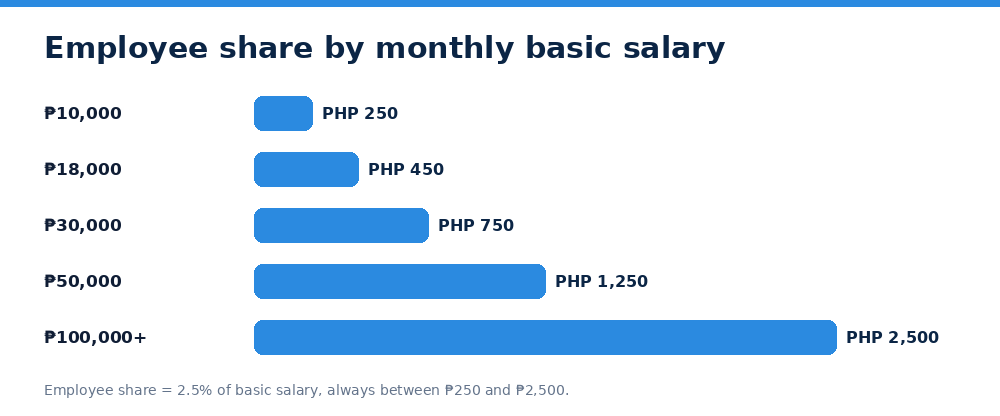
The number you care about on payday is your employee share — the 2.5% that is actually deducted. Because of the floor and ceiling, that share always lands between ₱250 and ₱2,500 per month, no matter how high the salary climbs.
A few worked examples make it concrete:
- A worker earning ₱18,000 pays 2.5%, or ₱450 a month.
- A supervisor earning ₱40,000 pays ₱1,000 a month.
- An executive earning ₱120,000 hits the ceiling and pays ₱2,500 — no more, even as the salary rises further.
It also means you can predict your annual PhilHealth cost easily: multiply your monthly employee share by 12. The worker earning ₱18,000, for instance, pays about ₱5,400 across the year, while a ceiling earner contributes ₱30,000 as an employee share.
One important detail: PhilHealth is computed on basic salary, not gross pay. Allowances, overtime, holiday premiums, and most bonuses are generally excluded from the base. That is why your PhilHealth deduction usually stays steady from month to month even when your take-home pay moves around.
Your PhilHealth contribution is also non-taxable, so it lowers the income on which BIR withholding tax is computed — a small silver lining on every deduction.
What your PhilHealth premium actually pays for
It is easier to accept a deduction when you know what it funds. Your PhilHealth premium keeps you an active member of the National Health Insurance Program, which subsidises a share of hospital and medical costs.
Active members can tap benefits such as:
- Inpatient coverage — case-rate payments toward hospital confinement, room, and treatment.
- Outpatient and day surgeries — including selected procedures that do not require an overnight stay.
- Konsulta package — free primary-care consultations, basic laboratory tests, and select medicines through registered Konsulta providers.
- Coverage for dependents — qualified family members can be listed under a single member.
Staying current matters. If premiums lapse, members may face benefit gaps or need to settle missed contributions before certain claims are honoured. That is why on-time employer remittance is not just paperwork — it protects real access to care.
The employer's half and how it is remitted
Your employer is not just a middleman. It matches your 2.5% peso for peso and is legally responsible for remitting the full 5% to PhilHealth on time.
The usual flow looks like this: the employer deducts your share from your salary, adds its own equal share, and pays the combined premium to PhilHealth. Payment is made through the Electronic Premium Remittance System (EPRS) or an accredited collecting agent, and it must be posted so your contributions stay active.
Deadlines depend on the employer's PhilHealth number, but as a rule premiums for a given month are due the following month. Late or missing remittances can trigger interest and penalties for the employer and, worse, can leave employees with contribution gaps that affect their benefit eligibility.
Employers should also keep employee PhilHealth Identification Numbers (PINs) accurate and up to date. A mismatched or missing PIN can cause posted premiums to fail to reflect against the right member, creating gaps even when the money was paid on time.
For small businesses, the admin load is real: compute per employee, apply the floor and ceiling, split the shares, generate the remittance list, and file on schedule — every single month. Getting one salary bracket wrong quietly compounds across a year.
New hires, raises, and other common situations
A few scenarios trip up employers and employees alike:
- New hires: coverage starts from the first month of employment. Compute the premium on their basic salary from day one, even for a partial month, unless your payroll policy prorates differently.
- Mid-year raises: when basic salary changes, recompute the premium on the new figure for the month the raise takes effect. There is no need to wait for a January reset.
- No pay for the period: if an employee earns no basic salary in a period (for example, extended unpaid leave), there is generally no premium to deduct for that period.
- Voluntary and self-employed members: they shoulder the full 5% themselves, since there is no employer to match it.
Because these edge cases are easy to miss, it helps to have a system that applies the floor, ceiling, and 2.5% split automatically rather than relying on a manual spreadsheet that someone has to remember to update. When an unusual case comes up, it is worth checking the latest PhilHealth advisories, since implementing rules are occasionally refined between circulars.
Get PhilHealth right every payday
PhilHealth in 2026 is refreshingly stable: a flat 5% rate, a clean 2.5% / 2.5% split, a ₱10,000 floor, and a ₱100,000 ceiling. Once you know those four numbers, every employee's premium falls neatly into place between ₱500 and ₱5,000 in total.
The catch is doing it consistently for every worker, every month, alongside SSS, Pag-IBIG, and withholding tax — and keeping the remittance lists ready to file. That is exactly the kind of repetitive, error-prone math that software should handle for you.
Sahodly computes PhilHealth, SSS, Pag-IBIG, and BIR withholding automatically for each payslip, applies the correct floors and ceilings, and generates your remittance summaries — so payday takes minutes, not hours. Try Sahodly free and let your payroll do the arithmetic.