How to Compute BIR Withholding Tax Under the TRAIN Law (2026)
What BIR withholding tax is (and why TRAIN matters)
Every time you release payroll in the Philippines, you are not just paying your employee. You are also acting as a collecting agent for the Bureau of Internal Revenue (BIR). A portion of each worker's compensation is withheld at source and remitted to the government, so that by year-end the employee has already settled most (ideally all) of their income tax. This is withholding tax on compensation.
The rules for how much to withhold come from the TRAIN law (Tax Reform for Acceleration and Inclusion, RA 10963). Its updated income tax schedule took full effect in 2023 and remains the current table for 2026. The headline benefit for ordinary earners is simple: the first PHP 250,000 of annual taxable income is effectively tax-exempt. Many minimum-wage and near-minimum-wage employees therefore owe zero income tax.
Getting this right protects everyone. Under-withholding leaves employees with a surprise balance due when they file, while over-withholding quietly shrinks their take-home pay for months before any refund. Consistent, correct computation keeps your payroll clean, your employees happy, and your BIR filings defensible if you are ever audited.
The good news is that the computation is not complicated once you see the shape of it. There is a table, a short list of deductions, and a bit of arithmetic. The rest of this guide walks through each piece, then puts it all together in a real peso example you can adapt to your own payroll.
The TRAIN annual tax table for 2026
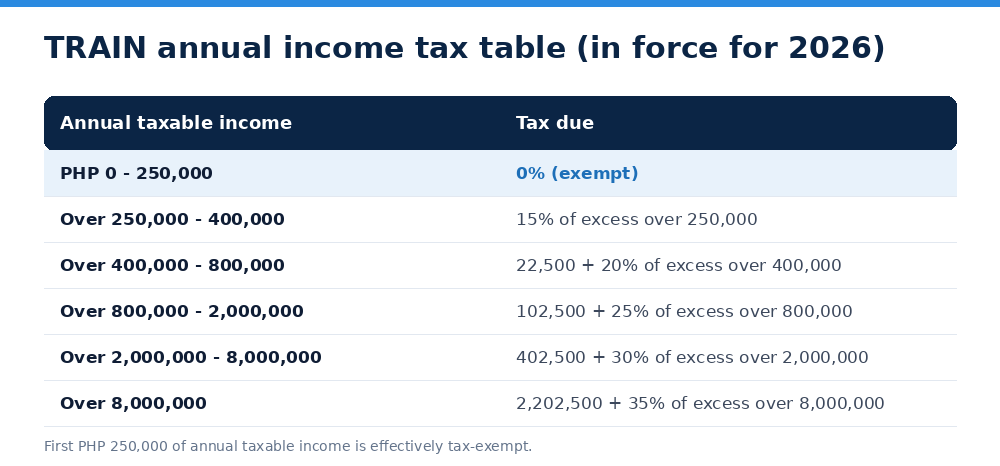
Withholding is ultimately an estimate of the employee's annual income tax, spread across pay periods. So it helps to start from the annual schedule. Here is the TRAIN table currently in force for 2026:
- PHP 0 to 250,000: 0% (tax-exempt)
- Over 250,000 to 400,000: 15% of the excess over 250,000
- Over 400,000 to 800,000: 22,500 + 20% of the excess over 400,000
- Over 800,000 to 2,000,000: 102,500 + 25% of the excess over 800,000
- Over 2,000,000 to 8,000,000: 402,500 + 30% of the excess over 2,000,000
- Over 8,000,000: 2,202,500 + 35% of the excess over 8,000,000
Notice how the tax is progressive: only the income that falls inside a higher band is taxed at that band's rate. A common myth is that crossing into a new bracket taxes your whole salary at the higher rate. It does not. Only the peso amounts above each threshold move up a rate, which is exactly what the fixed base amounts (22,500, 102,500, and so on) already account for.
In practice, BIR publishes revised withholding tax tables that break this annual schedule down into daily, weekly, semi-monthly, and monthly versions so employers can withhold the right amount each cutoff without doing the full annual math every time. Those per-period tables are derived from the same six bands above, so if your annual figure is correct, your per-period withholding will line up too.
The 4 steps to compute withholding tax
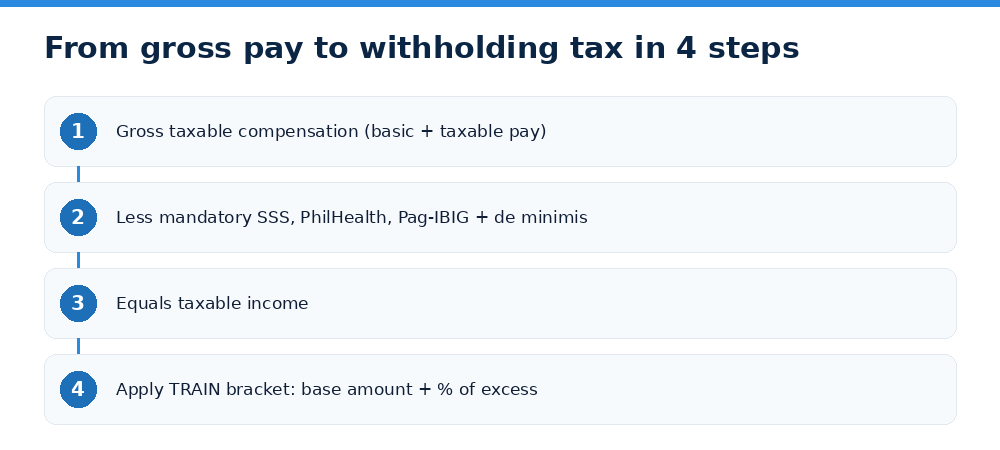
Whether you compute monthly, semi-monthly, or use the annualized method, the logic is the same. There are four moves from gross pay to tax:
- Start with gross taxable compensation. This is basic pay plus taxable allowances and taxable bonuses. Purely non-taxable items are excluded.
- Subtract mandatory contributions. The employee's shares of SSS, PhilHealth, and Pag-IBIG are non-taxable and come off the top. So do de minimis benefits within their legal limits.
- Arrive at taxable income. Gross taxable compensation minus those deductions equals the taxable base the tax table is applied to.
- Apply the TRAIN bracket. Find the band the taxable income falls into, take the fixed base amount, and add the stated percentage of the excess over that band's floor.
For payroll runs, you annualize (or use BIR's per-period tables), then divide the yearly tax across pay periods to get the amount withheld each cutoff. Below we walk through the annual view because it is the clearest way to see the mechanics.
A full peso example, start to finish
Meet Ana, a rank-and-file employee earning a monthly basic salary of PHP 50,000 (PHP 600,000 per year). Let's compute her annual withholding tax.
Step 1 - Gross taxable compensation: PHP 600,000 for the year (basic salary, no other taxable pay in this example).
Step 2 - Less mandatory contributions (monthly):
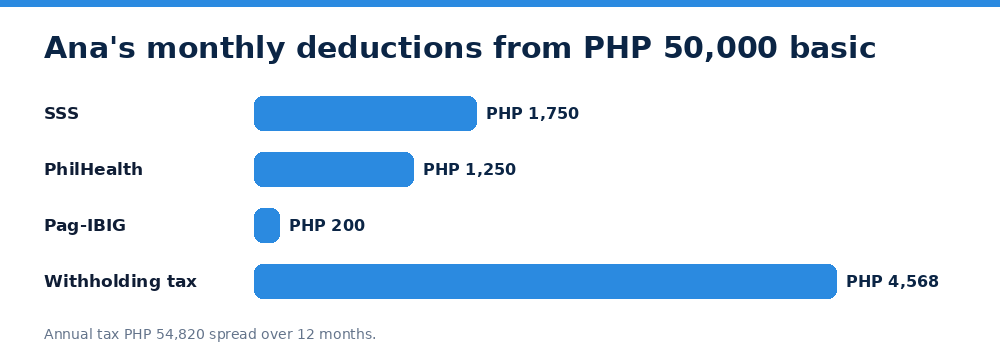
- SSS: employee share is 5% of the Monthly Salary Credit. Ana's salary is above the PHP 35,000 MSC ceiling, so her share is 5% x 35,000 = PHP 1,750.
- PhilHealth: 2.5% employee share of PHP 50,000 basic = PHP 1,250.
- Pag-IBIG: 2% capped at the PHP 10,000 computation ceiling = PHP 200.
Monthly contributions total PHP 3,200, or PHP 38,400 for the year.
Step 3 - Taxable income: PHP 600,000 - PHP 38,400 = PHP 561,600.
Step 4 - Apply the bracket: PHP 561,600 falls in the "Over 400,000 to 800,000" band: 22,500 + 20% of the excess over 400,000.
- Excess over 400,000 = 561,600 - 400,000 = 161,600
- 20% of 161,600 = 32,320
- Annual tax = 22,500 + 32,320 = PHP 54,820
Spread across 12 months, Ana's employer withholds roughly PHP 4,568 per month. (This simplified illustration sets aside 13th month pay, which is tax-exempt up to PHP 90,000.)
What you should NOT include as taxable
Over-withholding usually comes from taxing pesos that were never taxable in the first place. Under current rules, the following are excluded from the taxable base:
- Mandatory contributions: the employee's SSS, PhilHealth, and Pag-IBIG shares are non-taxable.
- De minimis benefits: small welfare benefits within BIR's prescribed ceilings, such as rice subsidy and uniform allowance, up to their limits.
- 13th month pay and other benefits: tax-exempt up to a combined ceiling of PHP 90,000 per year; only the excess is taxable.
Anything above these limits, plus taxable allowances and commissions, does count. When in doubt, the safe rule is: statutory contributions and clearly exempt benefits come off first, then you apply the table to what remains.
A quick sense check helps here. If Ana's PHP 90,000 combined benefit ceiling were fully used and she received, say, PHP 100,000 in 13th month and bonuses, only the PHP 10,000 excess would be added to her taxable income, not the whole amount. Keeping a clean record of what is exempt versus taxable, employee by employee, is what makes year-end annualization painless instead of a scramble.
Filing, forms, and staying compliant
Computing the tax is only half the job; you also have to remit and report it. The core BIR forms for compensation withholding are:
- 1601-C - Monthly Remittance Return of Income Taxes Withheld on Compensation. This is where you remit what you withheld each month.
- 2316 - Certificate of Compensation Payment / Tax Withheld, issued to each employee annually. For qualified employees, this supports substituted filing so they need not file their own return.
- 1604-C - Annual Information Return of Income Taxes Withheld on Compensation, filed with the Alphalist of employees.
A year-end annualization reconciles the total tax withheld against the tax actually due, so any small over- or under-withholding is trued up on the final pay period. Missed deadlines and mismatched Alphalists are among the most common findings in a BIR audit, so accuracy month to month pays off.
This article is general information, not tax advice; verify edge cases with the BIR or your accountant. Sahodly applies the current TRAIN table, computes SSS, PhilHealth, and Pag-IBIG automatically, and generates your 1601-C figures each cutoff, so payroll math stops being a monthly headache. Try Sahodly free and let the withholding compute itself.