13th Month Pay in 2026: Who Gets It and How It's Computed
What Is 13th Month Pay?
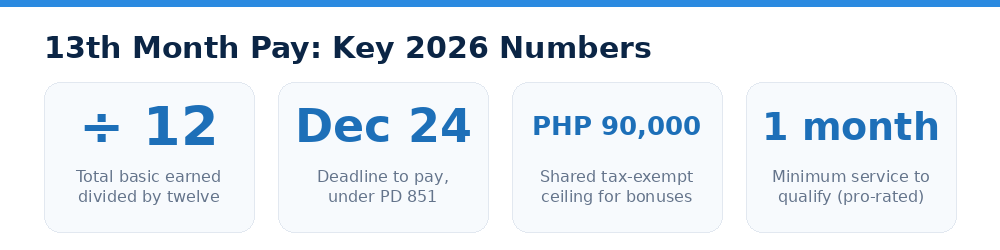
13th month pay is a mandatory year-end benefit that every covered private-sector employee in the Philippines must receive. It is not a bonus that owners can give or withhold at will. It is required by Presidential Decree No. 851 (PD 851), which has been in force since 1975, and it must be paid on or before December 24 every year.
Think of it as one extra month's worth of basic pay, spread across the year and released before the holidays. For many Filipino families, it is the money behind Noche Buena, tuition down-payments, and paying down debt. For employers, it is a hard deadline with real penalties for non-compliance, so it pays to understand the rules early rather than scrambling in December.
This guide walks through who is entitled, the exact 13th month pay computation, a pro-rated worked example, and how the PHP 90,000 tax-exempt ceiling affects take-home pay in 2026.
Who Is Entitled to 13th Month Pay?
Coverage under PD 851 is broad but not universal. To qualify, an employee must meet these conditions:
- Rank-and-file employees are covered, regardless of position, designation, or how they are paid (monthly, daily, piece-rate). Managerial employees who have the power to hire, fire, and set policy are not legally entitled, though many companies grant it anyway as a matter of practice.
- The employee must have worked at least one (1) month during the calendar year.
- It applies whether the employee is still employed at year-end or has already resigned, retired, or been separated during the year.
Because the benefit only requires one month of service to trigger, part-year employees still get something. They simply receive a pro-rated amount based on how much basic salary they actually earned. Resigned and separated employees are entitled to their pro-rated 13th month pay as part of their final pay, computed up to their last day of work.
A few common cases are worth flagging. Probationary and project-based employees are covered just like regular staff, as long as they hit the one-month threshold. Employees paid purely on commission with no fixed basic wage may fall outside coverage, but if they have a guaranteed basic component, that component counts. When in doubt about a borderline arrangement, treat the worker as covered and compute on the basic-wage portion — it is the safer, more defensible position under DOLE scrutiny.
The 13th Month Pay Formula
The rule is refreshingly simple. Under PD 851 and its implementing rules:
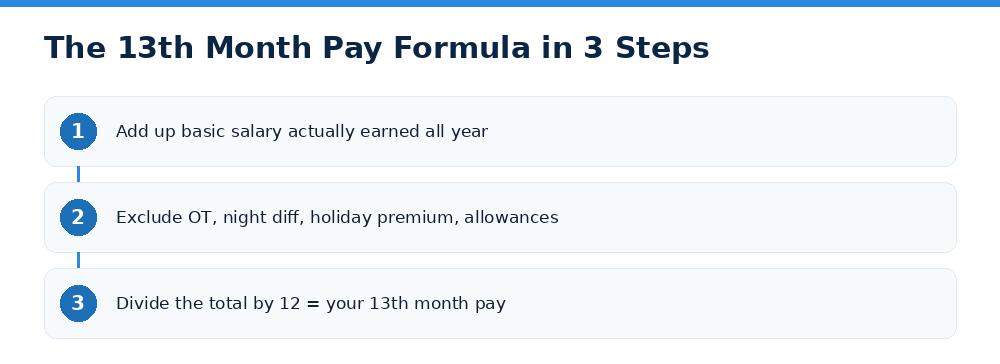
13th Month Pay = Total basic salary actually earned during the year ÷ 12
The key phrase is basic salary actually earned. You add up the basic pay the employee genuinely received across the year, then divide by twelve. This design means pro-rating happens automatically: someone who only worked part of the year, or who had unpaid absences, will have a smaller total to divide, so their 13th month pay shrinks proportionally without any special formula.
What counts and what does not can trip up new employers. These are excluded from basic salary for this computation:
- Overtime pay
- Holiday premium and premium pay for rest days or special days
- Night shift differential
- Cost-of-living allowance (COLA) and other allowances
- Cash conversions of unused leave, and other monetary benefits not integrated into basic pay
In short, only the basic wage goes into the pot. Strip out the premiums and allowances first, sum what remains, and divide by 12. If an allowance has been formally integrated into basic salary through company policy or a collective bargaining agreement, it does count — but standard COLA and transport or meal allowances almost always sit outside the basic wage and should be left out.
A Pro-Rated Worked Example
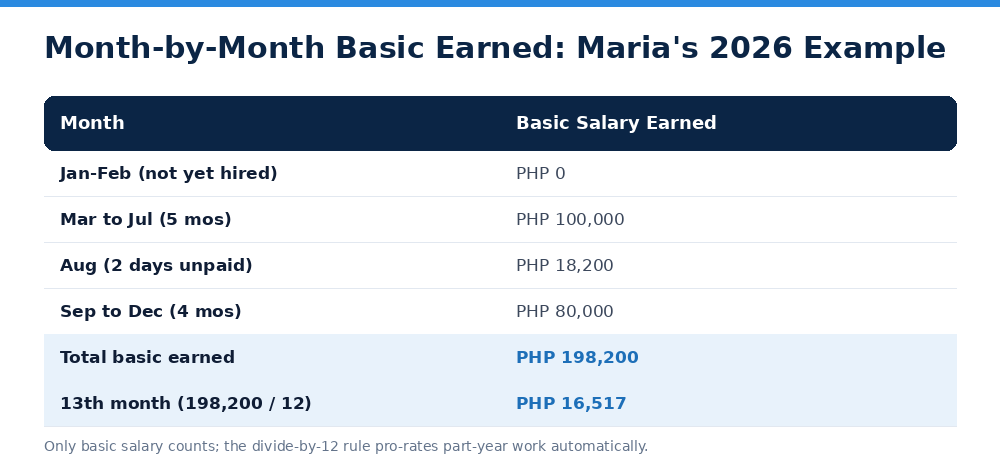
Let us make it concrete. Say Maria is a rank-and-file employee earning a basic salary of PHP 20,000 per month. She was hired on March 1, 2026 and works through the end of the year. Because she started in March, she does not earn a full twelve months of basic pay.
From March to December, Maria works 10 full months, earning PHP 20,000 each month for a total basic salary of PHP 200,000. Assume one month (August) included two days of unpaid absence, reducing that month's basic to roughly PHP 18,200. Her adjusted total basic earned for the year is about PHP 198,200.
Her 13th month pay is:
PHP 198,200 ÷ 12 = PHP 16,517 (approx.)
Notice she does not receive a full PHP 20,000. Because 13th month pay divides by 12 regardless of how many months were worked, a part-year employee naturally lands below one full month's salary. A worker employed for the entire year with no unpaid absences, earning PHP 20,000 monthly, would total PHP 240,000 and receive exactly PHP 20,000 (240,000 ÷ 12) — one clean month of basic pay.
Is 13th Month Pay Taxable? The PHP 90,000 Ceiling
Good news for most employees: 13th month pay is tax-exempt up to PHP 90,000. This ceiling is shared with other benefits and bonuses — such as a 14th month pay, productivity incentives, and Christmas bonuses. Only the combined amount exceeding PHP 90,000 becomes taxable and is added to the employee's taxable income for the year.
In our example, Maria's PHP 16,517 is comfortably below the ceiling, so she pays no tax on it at all. Even an employee receiving a full PHP 20,000 13th month pay stays fully exempt.
Where does the ceiling bite? Consider a manager-level rank-and-file employee with a basic salary of PHP 100,000 per month. A full-year 13th month pay would be PHP 100,000. Of that, PHP 90,000 is tax-exempt and the remaining PHP 10,000 is taxable — it gets added to annual taxable income and taxed at the applicable BIR rate. If that same employee also receives a Christmas bonus, the bonus eats into the same PHP 90,000 window, pushing even more of the total into taxable territory.
Remember: the PHP 90,000 is a single shared bucket for 13th month pay and all similar bonuses in the year, not a fresh exemption for each one. This is different from the PHP 250,000 annual income that is already tax-exempt under the TRAIN law tables — the two thresholds are separate and do not stack against each other. For payroll purposes, the taxable excess above PHP 90,000 is simply folded into the employee's regular taxable compensation and withheld accordingly.
Deadlines, Records, and Common Mistakes
A few practical reminders keep you compliant and audit-ready:
- Deadline: Pay on or before December 24. Some employers release half mid-year and the balance in December — that is allowed, as long as the full amount lands by the deadline.
- Reporting: Employers must file a compliance report with the DOLE regional office, typically by January 15 of the following year.
- Don't confuse it with a bonus: 13th month pay is mandatory; a Christmas bonus is discretionary. They are separate, though both share the PHP 90,000 tax-exempt ceiling.
- Don't include premiums: The single most common error is adding overtime, night differential, or allowances into the base. Only basic salary actually earned counts.
- Pro-rate correctly: New hires, resignees, and employees with unpaid leave earn less basic salary, so their 13th month pay is automatically lower — dividing by 12 handles this.
The math is simple, but doing it by hand across dozens of employees — each with different start dates, absences, and adjustments — is where errors creep in. Sahodly tracks basic salary earned month by month and computes each employee's 13th month pay and taxable excess automatically, so December is calm instead of chaotic. Try Sahodly free and let your payroll do the counting.